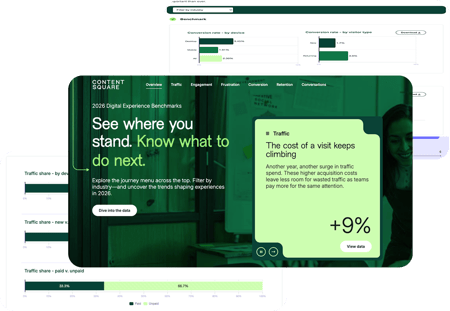
2026 Digital Experience Benchmarks for Product Leaders
Benchmark experience quality, friction, and retention. Identify what to fix when every interaction must count.
Sessions are shorter, but they start better prepared. Visitors have done their research through AI and expect relevance immediately.
The 2026 Benchmarks reveal where product teams are winning: reducing foundational friction (slow loads down -20%), catching new risks early (API errors up +16%), and earning repeat visits that drive 2.3x more engagement. Compare your experience quality, friction, and retention to peers, and identify the fastest levers to improve outcomes
Key KPIs
-
Engagement & intent signals
Why it matters:
Sessions are shorter as visitors arrive more informed. Consumption declined -10%, time on site fell -7%, but bounce rates improved. Visitors expect relevance immediately.
Top insights:
- Consumption metrics: page views per session down -1%, scroll rate down -2%—visitors are consuming less but arriving with clearer intent
- Time on site: down -7%—sessions are faster but more purposeful
- Bounce rates by traffic source: AI-referred (-5%), organic search (-4%), paid search (-3%)—lower bounce = visitors found relevance quickly
- Desktop vs. mobile engagement: desktop = 30% of visits but 47% of time—desktop sessions are deeper and more exploratory
- Activity rates: user interactions (clicks, taps, swipes) on homepage, product listing pages, and product detail pages
How to beat the benchmark
Refine above-the-fold to surface relevance fast. Design desktop for deep exploration. Use Journey Analysis to spot drop-off patterns. Teams using digital experience monitoring (DXA) frequently see +34% higher homepage activity, +5% on PLPs, +6% on PDPs.
-
Friction & Experience Quality
Why it matters:
Frustration is falling (-4.3%) as slow loads decline (-20%), but API errors are rising (+16%). Small friction reductions extend journeys meaningfully.
Top insights:
- Overall frustration rate: down -4.3%—fewer visitors are experiencing dead clicks, rage clicks, or errors
- Slow page loads: now affecting 10.9% of sessions (down -20%)—foundational performance is improving
- API errors: up +16%—new sources of technical friction are emerging as experiences become more modular
- Rage clicks impact: reducing rage clicks by 1.5 percentage points per page extends the average session by +1 page view
How to beat the benchmark
Fix slow loads and API errors using Error Analysis and Experience Monitoring. Use Session Replay with AI summaries to surface frustration fast. Frequent digital experience monitoring (DEM) users reduced frustration to 35.1%, compared with 37.0% for other teams. That improvement also shows up in session quality. Bounce rates are 3.8 percentage points lower (45.4% vs. 49.2%) for frequent DEM users, helping more visitors to stay engaged and continue through the journey.
-
Conversion & revenue resilience
Why it matters:
Conversion declined -5%, but revenue per visit (RPV) increased +1% (Average Order value (AOV) up +6%). Repeat visitors proved more resilient (conversion down -4%), and AI-referred traffic conversion jumped +55%.
Top insights:
- Revenue per visit (RPV): up +1%—even with fewer conversions, each visit is generating more value
- Conversion rate: down -5% overall, but down just -4% for repeat visitors—returning customers are more resilient
- Average order value (AOV): Up +6%—customers are spending more per transaction
- AI-referred traffic conversion: up +55% year over year, now at 1.26%—AI-driven visitors are highly qualified
- Repeat visitor conversion advantage: 2.9% conversion vs. 1.7% for new visitors
How to beat the benchmark
Use Impact Quantification to prioritize work based on real conversion lift. Optimize for repeat visitors who convert at 70% higher rates.
-
Retention & repeat visitors
Why it matters:
Repeat visitors = 53% of visits (down -2% vs. -5.8% for new). They view +2.3 more pages/session and brands with highest returning traffic see +35% higher conversion (Retail).
Top insights:
- Repeat vs new visitor split: repeat visitors = 53% of all visits (declining just -2% vs. -5.8% for new traffic)
- 30-day retention rates: mobile retention up +10%, desktop down -7%
- Engagement depth: repeat visitors view +2.3 more pages per session and spend +87% more time on site
- Conversion lift: retail brands with the highest share of returning visitors see +35% higher conversion rates
How to beat the benchmark
Use Retention and Cohort Analysis to understand what drives repeat usage. Use Journey Analysis to connect behavior across sessions and devices. Build experiences users want to return to.
Top insights:
- Consumption metrics: page views per session down -1%, scroll rate down -2%—visitors are consuming less but arriving with clearer intent
- Time on site: down -7%—sessions are faster but more purposeful
- Bounce rates by traffic source: AI-referred (-5%), organic search (-4%), paid search (-3%)—lower bounce = visitors found relevance quickly
- Desktop vs. mobile engagement: desktop = 30% of visits but 47% of time—desktop sessions are deeper and more exploratory
- Activity rates: user interactions (clicks, taps, swipes) on homepage, product listing pages, and product detail pages
How to beat the benchmark
Refine above-the-fold to surface relevance fast. Design desktop for deep exploration. Use Journey Analysis to spot drop-off patterns. Teams using digital experience monitoring (DXA) frequently see +34% higher homepage activity, +5% on PLPs, +6% on PDPs.
Top insights:
- Overall frustration rate: down -4.3%—fewer visitors are experiencing dead clicks, rage clicks, or errors
- Slow page loads: now affecting 10.9% of sessions (down -20%)—foundational performance is improving
- API errors: up +16%—new sources of technical friction are emerging as experiences become more modular
- Rage clicks impact: reducing rage clicks by 1.5 percentage points per page extends the average session by +1 page view
How to beat the benchmark
Fix slow loads and API errors using Error Analysis and Experience Monitoring. Use Session Replay with AI summaries to surface frustration fast. Frequent digital experience monitoring (DEM) users reduced frustration to 35.1%, compared with 37.0% for other teams. That improvement also shows up in session quality. Bounce rates are 3.8 percentage points lower (45.4% vs. 49.2%) for frequent DEM users, helping more visitors to stay engaged and continue through the journey.
Top insights:
- Revenue per visit (RPV): up +1%—even with fewer conversions, each visit is generating more value
- Conversion rate: down -5% overall, but down just -4% for repeat visitors—returning customers are more resilient
- Average order value (AOV): Up +6%—customers are spending more per transaction
- AI-referred traffic conversion: up +55% year over year, now at 1.26%—AI-driven visitors are highly qualified
- Repeat visitor conversion advantage: 2.9% conversion vs. 1.7% for new visitors
How to beat the benchmark
Use Impact Quantification to prioritize work based on real conversion lift. Optimize for repeat visitors who convert at 70% higher rates.
Top insights:
- Repeat vs new visitor split: repeat visitors = 53% of all visits (declining just -2% vs. -5.8% for new traffic)
- 30-day retention rates: mobile retention up +10%, desktop down -7%
- Engagement depth: repeat visitors view +2.3 more pages per session and spend +87% more time on site
- Conversion lift: retail brands with the highest share of returning visitors see +35% higher conversion rates
How to beat the benchmark
Use Retention and Cohort Analysis to understand what drives repeat usage. Use Journey Analysis to connect behavior across sessions and devices. Build experiences users want to return to.
For Product leaders, the mandate is not to keep users browsing longer. It’s to recognize context faster and respond with experiences that feel immediately relevant.
That means delivering the right content, products, and offers based on what’s known about the visitor, whether they arrive informed by AI or return with a prior history and intent.
Put the benchmarks to work
Use the Benchmark Data Explorer to filter by your industry and compare how your traffic mix, engagement rates, and repeat visitor performance stack up against relevant peers. Spot the KPIs where you're below the benchmark, and the journey stages where small fixes can deliver measurable lift.